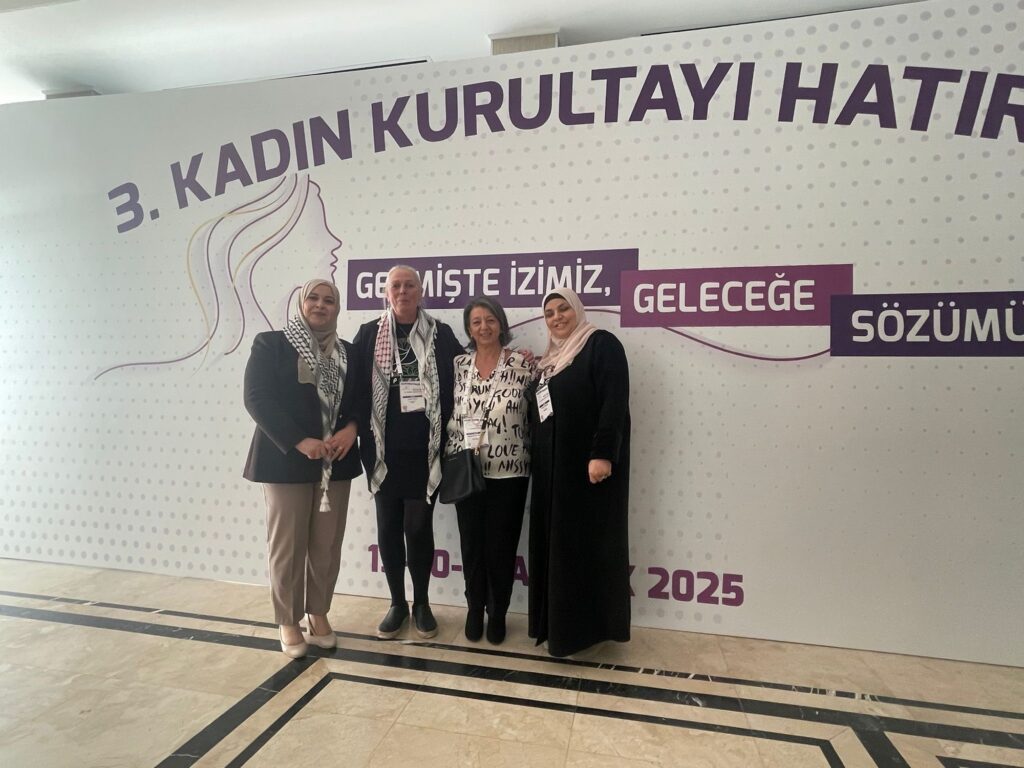
19th–21st December 2025, Ankara, Turkey
The Women’s Congress was held at Ankara Bilkent Hotel from the 19th to the 21st of December with the slogan “We Have a Mark in the Past, We Have a Promise for the Future!”.
The congress started with a moment of silence with applause in memory of the women lost in the struggle for labour, peace and democracy. This was followed by opening speeches from Education Sen Central Women’s Secretary Simge Yardım, KESK Co-Chair Ayfer Koçak and KESK Women’s Secretary Döne Gevher.
After the guests’ speeches to the conference, the international guests spoke about the situation in their countries. There was a large international delegation:
Sevşen Dandana Özerce and Sevgi Erhalaç (Cyprus KTOS),
Arzu Kurtdereli and Misli Çağansoy (Cyprus KTOEÖS),
Suzan Özdilek and Yeşim Dede (Cyprus EMU-SEN),
Tiam Breidenich (Germany GEW),
Paiman Artoshi (Iraq KTU),
María Del Barrio Colmena and Iria Antuña Domínguez (FECCOO, Spain),
Sonia Blanco Esquivias and Marta Arias Monanchel (STEs-i Organizacion de Mujeres, Spain),
Graziamaria Pistorino (FLC-CGIL, Italy),
Merlin Trajkovic (Serbia TUS),
Louise Regan (UK NEU),
Catarina Teixeira (Portugal PENPROF),
Iman Al-Shayeb (Palestine GUPT),
Firdous Ibraheim (Palestine PGFTU) and
Claire Gueville (France SNES-FSU).
Following this there were a number of workshops on key issues facing the women’s movement and education currently. These covered the following themes:
Education Policies, Discrimination and Sexism Transformation of Employment Forms and Women’s Labor Family, Body Politics and Gender Inequality Women’s Struggle in the Context of War, Migration, Peace Equality, Freedom, Secularism Struggle and Publicity Women in Trade Union Struggle
Feedback from each of the workshops was shared the following day, with a number of themes being raised by delegates. Disabled children and their access to education was a key concern — data on this is not readily accessible, so the data shared was not up to date. Delegates talked about education being a right for all, and highlighted cases taken to the European Court of Human Rights regarding lack of access and discrimination by Turkey.
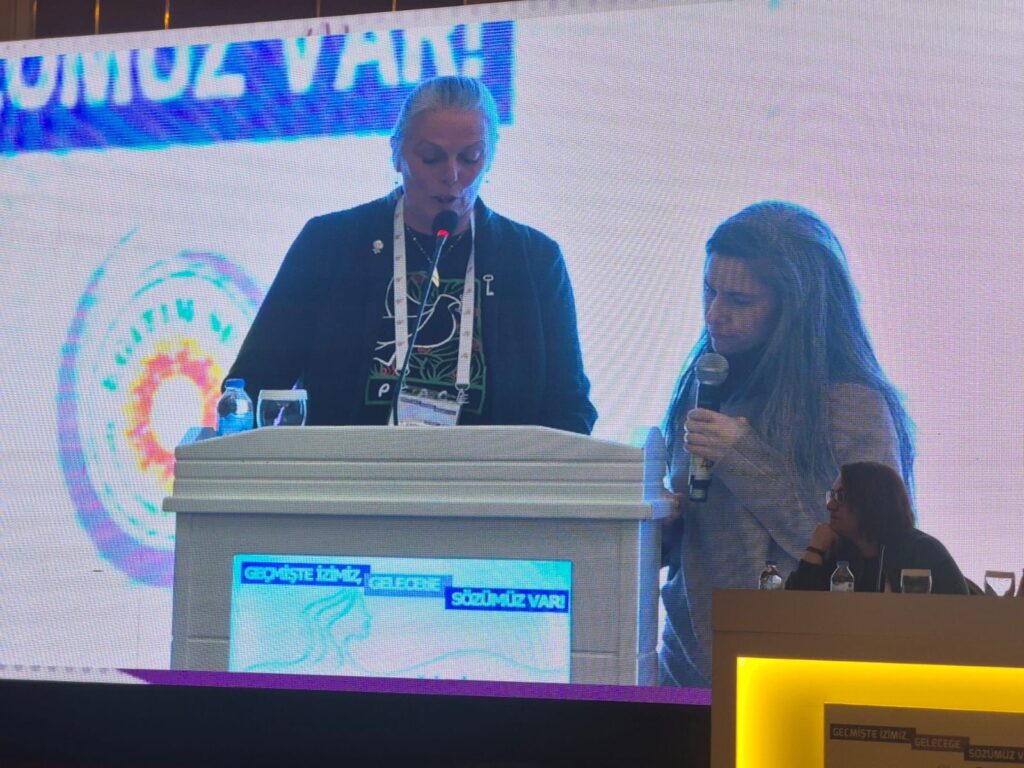
There were concerns that the current compulsory education system turns education into a means of pressure and oppression. The workshop participants believed that education should be designed for liberation and have emancipation at its heart. Education should be publicly funded and all should have access to education in their mother tongue where everyone’s access is made possible.
The education system currently reflects the patriarchal system in which we live. The feminist struggle is a struggle against all forms of violence, and violence against women and LGBT+ people has increased. Over the last 23 years the AKP government has commercialised and marketised education. Education should be perceived as a right for everyone. The feminist movement needs to be leading on the education system — women, gender equality and LGBT+ equality need to be at the heart of the system.
The government is against mixed education and this is seen as an attack on secularism. In 2021 the government withdrew from the Istanbul Convention. The school system should be open to all identities and the curriculum should cover all cultures. However, the system is increasingly promoting private education and young girls’ right to education is being systematically limited. Public and free education should be promoted.
Child labour is a systematic and structural problem. One child in four aged 15–17 is employed, but this does not include unrecorded labour. Children should not be accepted as workers. Integrating children into work supports the needs of capitalism and deteriorates the rights of the child.
Vocational training programmes are creating a path for children to work — they do not protect the child. Children are now in workplaces working. According to labour law, students are “in training”, but they are effectively workers. Children under 18 are prohibited from heavy or dangerous work, but vocational training allows this to be avoided. Children are now working in construction and some have died. In 2025, 17 children died in workplaces. Vocational training schools should be restructured or closed.
The right to education is a social right and learning in your mother tongue is a fundamental right. The current system is having an impact on migrant and refugee children — families are worried about their children going to school. Legal amendments are needed to ensure children have access to mother tongue education. Education can be delivered in more than one language. This is an issue of freedom and democracy, and regulations should ensure children have access to mother tongue education while also learning other languages in the region.
On the final day, delegates discussed the proposals and then approved the final declaration.
The Education Sen Women’s Conference agreed the importance of organising a stronger women’s struggle in the coming period against the attacks on women’s labour, bodies, rights and lives.

